Landing Page Design
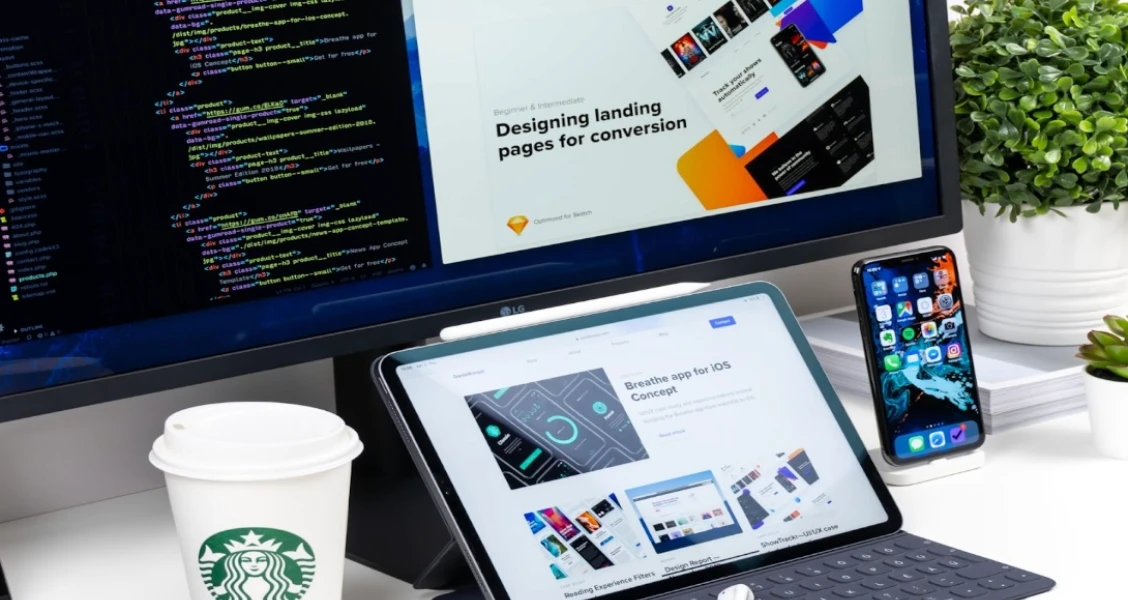
A good landing page does one job: it helps the right shopper make a confident decision, fast.
Most underperforming landing pages fail for the same reasons. They are trying to do too much, they bury the point, or they ask for a purchase before they have earned trust. When traffic is expensive and attention is short, structure matters more than clever copy.
Here’s the anatomy of a high-converting Shopify landing page and how to build one that drives clicks, add-to-carts, and purchases.
1. A clear promise above the fold
Your first screen should answer three questions instantly:
What is this?
Who is it for?
Why should I care right now?
High-converting pages lead with a simple value statement and remove the need to interpret.
What to include above the fold:
A headline that states the primary benefit
A short supporting line that clarifies who it’s for or what problem it solves
One primary call-to-action (CTA)
A hero visual that shows the product in context
If your hero section could apply to any brand, it is not specific enough.
2. Trust signals right away
Shoppers are skeptical by default. High-converting pages earn attention with proof early, not at the bottom.
Fast trust builders:
Star rating and review count
“As seen in” logos (only if true)
Press quotes or creator callouts
Shipping and returns highlights
Security and payment reassurance
You do not need all of these. You need the ones that address the buyer’s biggest hesitation.
3. A focused CTA strategy
Landing pages convert better when the CTA is consistent. Multiple competing buttons and mixed messaging usually reduce action.
Best practices:
One primary CTA repeated throughout the page
Sticky CTA on mobile for long pages
Use the same language each time (ex: “Shop the Drop” not “Buy Now” then “Learn More”)
If you want someone to buy, do not hide your CTA until the end.
4. A “why this, why now” section
People do not buy because a product exists. They buy because it solves something, fits their identity, or feels like the right moment.
High-converting pages answer:
What makes this different?
What makes it worth the price?
Why should I act today?
This is where you introduce:
The differentiator (materials, design, formula, function)
The reason to act (limited drop, seasonal need, bonus, shipping cutoff, deadline)
Keep it skimmable. This section should feel like clarity, not a brand essay.
5. Benefits shown as outcomes, not features
Features tell. Outcomes sell.
Instead of listing specs, translate them into what changes for the customer:
“Lightweight nylon” becomes “easy to carry all day without feeling bulky”
“Stainless steel” becomes “built to last and still look new after daily use”
“Natural ingredients” becomes “gentle enough for daily use without drying you out”
A great landing page reads like it understands the customer’s life, not just the product details.
6. Social proof placed where decisions happen
A review widget at the bottom is not enough. The best landing pages place proof next to the claim it supports.
High-converting placements:
Review highlights near the first CTA
Photo or video UGC near the benefits section
Testimonials next to pricing or bundle callouts
“Customers love it for…” bullets tied to real quotes
Think of social proof as reinforcement, not decoration.
7. Objection handling built into the flow
Every product has friction points. High-converting pages handle objections before the shopper has to ask.
Common objections to address:
Shipping speed and cost
Returns and exchanges
Sizing and fit
What’s included
How it compares to alternatives
How long results take (for beauty and wellness)
A simple FAQ accordion works, but it is even better when you answer objections inline near the relevant section.
8. A strong product moment that makes it feel real
At some point, the page should shift from persuasion to visualization.
This can be:
A short video demo
An unboxing clip
A “3 ways to wear it” section
A comparison chart
A lifestyle grid showing the product in real situations
Shoppers are trying to picture ownership. Make that easy.
9. Smart merchandising that protects conversion
Landing pages often fail because they overwhelm. High-converting pages limit choices and guide shoppers to the best option.
Do this:
Feature one hero product or collection
Provide a clear best-seller or “recommended” option
Keep product tiles tight and purposeful
Use bundles only when the value is obvious
If your landing page has ten products and no direction, shoppers will bounce or stall.
10. A clean mobile experience
Most Shopify traffic is mobile. If the page is hard to scan on a phone, it will not convert no matter how good the offer is.
Mobile must-haves:
Short sections with strong headers
Large tap targets and buttons
Sticky CTA for long pages
Compressed media that loads quickly
Clear spacing so content doesn’t feel crowded
If mobile feels heavy or chaotic, conversion will suffer first.
11. A close that reduces risk
The best landing pages end by making the decision feel safe.
Great closing elements:
A final proof moment (best testimonial, press quote, UGC)
A clear reminder of shipping and returns
A final CTA with consistent language
Optional: a last nudge (limited quantity, deadline, bonus)
Your ending should feel like reassurance, not pressure.
A simple landing page structure you can copy
If you want a clean blueprint, here’s a proven order:
Hero: promise + CTA
Trust: reviews, shipping, press
Differentiator: why this is better
Benefits: outcomes + visuals
Proof: UGC and testimonials
Product moment: demo, comparison, or styling
Objections: FAQ, shipping, returns
Close: reassurance + final CTA
The takeaway
High-converting landing pages are not longer, louder, or more clever. They are clearer. They reduce uncertainty, show proof early, and guide the shopper to the next step without distraction.
Recent Post